A tenant or a business unit asks for a few hundred kilowatts of new IT load and it sounds like a bigger order of the same thing. At enterprise scale, that request quietly asks the building for capacity it was never designed to carry, and the hardest constraints sit on the utility side, where lead times are long and outside your control.
The request sounds simple; the building disagrees
We hear a version of this often: a group is standing up a new data center, consolidating closets into a real MDF, or adding racks for an AI workload, and the ask lands as “we need more power.” On paper it reads like an incremental change. In the field it rarely is.
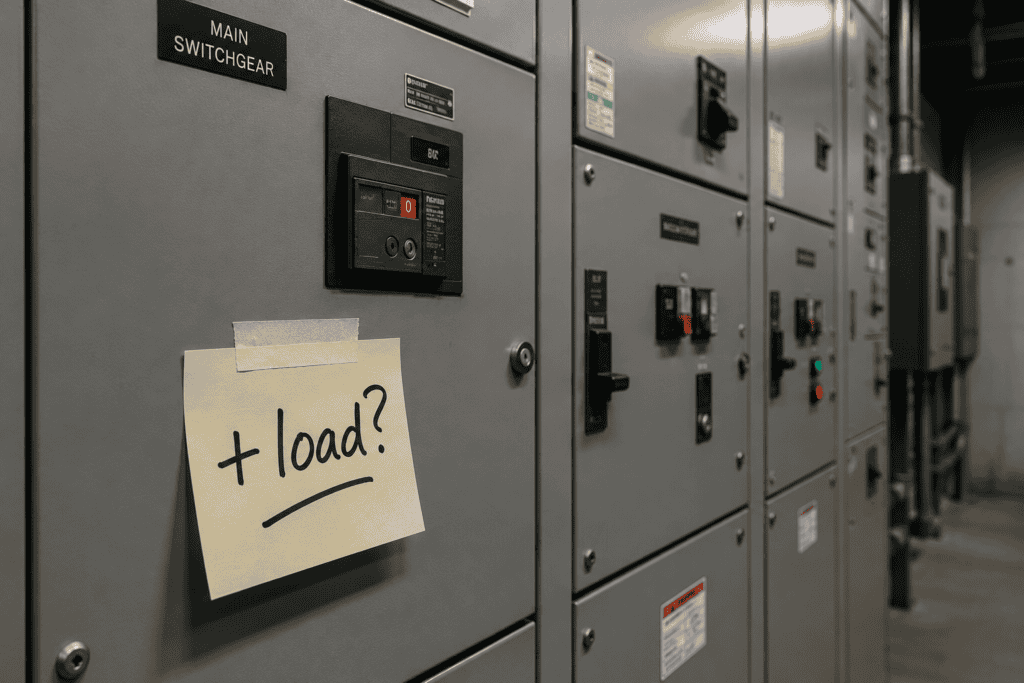
A building’s electrical system is a chain, and every link was sized for the load that existed when the building was designed. Add a few hundred kilowatts of continuous IT load (a modest number next to hyperscale, but a large number for an existing facility) and you are testing every link at once: the utility service, the service entrance, the main switchgear, the distribution, and the branch circuits at the rack. The request doesn’t ask for one upgrade so much as it asks whether the whole chain still holds.
Start at the service entrance
The service entrance is where most of these projects meet reality. It has a finite ampacity, set years ago, and a new load can consume a surprising share of it. Before anything else, the question is simple and unforgiving: how much headroom is actually left between the building’s present peak demand and the rated capacity of the service?
In our experience, that headroom is smaller than people assume, because it has already been quietly eaten by prior tenant improvements, added rooftop units, and equipment nobody documented. A load calculation on paper from the original design is not the same as measured demand today. The gap between them is where projects get into trouble.
Switchgear, distribution, and the room you didn’t budget for
If the service can carry the new load, the next question is whether the switchgear and distribution can. Main switchgear has a rating; adding a large new feeder may exceed it, or leave too little margin for the next expansion. New distribution equipment needs physical space, working clearances, and often a dedicated electrical room that the tenant fit-out never planned for.
This is the point where a “just add power” request turns into a coordination problem across the electrical, mechanical, and architectural sides at once. A common issue we see: the power side gets solved on its own, and then there’s nowhere code-compliant to put the gear that solves it.
The utility side: service upgrades and transformer lead times
Here is the part most teams underestimate, because it is the part they can’t control. If the new load exceeds what the existing service can deliver, you need a utility service upgrade, and that moves at the utility’s schedule, not the project’s. A larger pad-mounted or utility transformer can carry a lead time measured in many months, and for larger power transformers it can stretch past a year.
That single fact reshapes the schedule. You can have drawings approved, gear selected, and crews ready, and still be waiting on a transformer while the go-live date sits on the calendar untouched. Power availability, not construction speed, becomes the critical path. This is also why getting transformer lead times onto the calendar early matters more than almost any other single decision. It’s one reason Access now represents utility-scale transformers, so shorter available lead times can help power reach the site sooner.
The load that rides along
One more thing a big power request quietly asks for: the cooling to match it. A few hundred kilowatts of IT load is a few hundred kilowatts of heat that has to leave the room. The power conversation and the thermal conversation are the same conversation, and splitting them is how a data center ends up powered but not operable. We flag it here not to solve it in this article, but because a power plan that ignores the heat it creates is only half a plan.
Redundancy multiplies the number
There’s a quieter multiplier most first estimates miss: reliability. A data center that matters usually isn’t served by a single path. If the load needs to ride through a utility outage or a maintenance window, the request isn’t just for the IT load: it’s for the UPS, the generator, the automatic transfer scheme, and often a second service or feeder to back the first. Design the room for concurrent maintainability and the electrical footprint grows again, because you’re now sizing for the case where one path is out and the other carries everything.
That’s not a reason to over-build. It’s a reason to decide the reliability target before you size anything, because a 300-kilowatt IT load at N is a very different building problem than the same load at N+1 with a generator behind it. We’ve watched teams price the first, commit a date, and then discover they were actually buying the second. Naming the tier up front keeps the service, the switchgear, the standby plant, and the transfer equipment all sized to the same story instead of three different ones.
The cost of being brought in late
Nearly all of this is manageable when it’s caught early and expensive when it isn’t. The pattern we see repeatedly: the electrical reality gets checked at rough-in, the service turns out to be short, and now the fix is a utility upgrade and a long-lead transformer dropped into the middle of an active construction schedule. Costs climb, dates slip, and the options narrow to the expensive ones.
Engaging before the building design is locked is where that time and money get recovered. A load study early, mapped against real measured demand and the utility’s actual service capacity, tells you whether you’re doing a panel change or a service upgrade, while you still have cheap ways to respond.
Getting ahead of it
If you’re planning a data center, an MDF/IDF buildout, or any significant load addition to an existing building, the most useful first move isn’t selecting equipment but finding out what your service entrance actually has left to give, and what the utility timeline looks like if the answer is “not enough.”
That early load-and-service assessment is the work Access would rather do at concept than at rough-in. If a power request is on your horizon and you’re not sure what it’s really asking of your building, that’s a good conversation to have before the design is set.