Save Your Time and Money with These Expert Server Rack Setup Tips
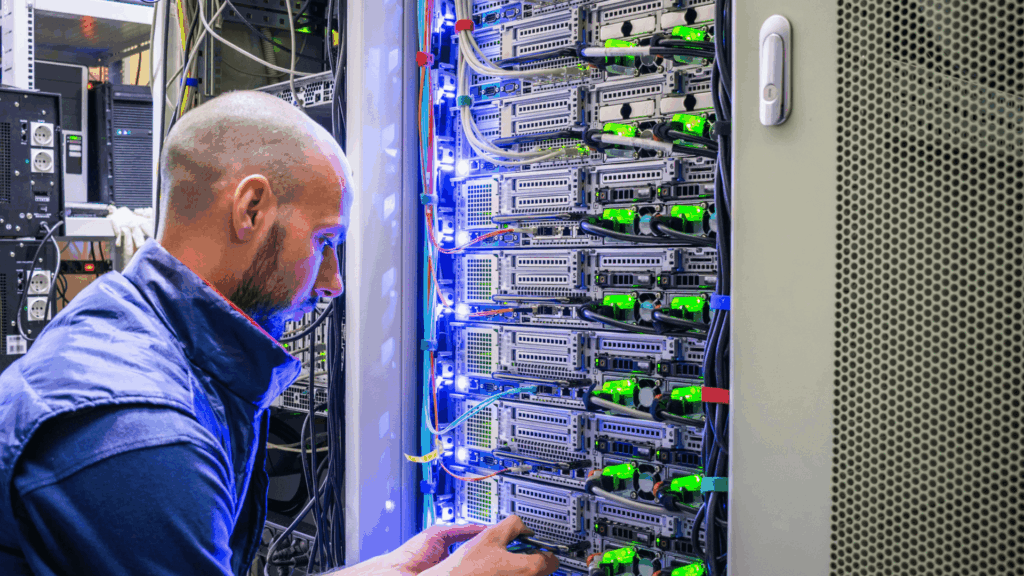
Depending on your server rack power setup, you could be wasting money. Whether you have one server rack or multiple, if it isn’t configured properly, you will face growing inefficiencies. Preventing this starts with the right server rack power setup. Ensure your server rack is running smoothly by following these tips:
- Determine Your Power Requirements
- Pick the Right Equipment
- Design a Reliable Power Path
- Utilize Advanced Monitoring
We’ll cover all these steps in this article and provide a guide at the end to help you pick the right PDU for your facility.
Determine Your Power Requirements
If you don’t know how much power the equipment in your server rack needs, you won’t be able to design the right power setup. And if you pick the wrong setup, your equipment will struggle to operate efficiently, and you will have wasted your time and money.
Determining your facility’s power requirements largely depends on your power source. Your rack PDU must be able to deliver that amount of power to your equipment. To find the right rPDU configuration for your facility, follow these steps:
- Check each piece of equipment’s manual or backplate to determine its amperage or voltage. Add these together for the total load in your rack.
- Add 20% to the total power requirements to leave room for future growth.
- Determine your redundancy goals to learn if you need a single or dual power feed.
- Identify the voltage and phase available at your rack.
Additionally, you will need to ensure your new rack PDU fits your rack’s physical needs. Therefore, your chosen rPDU should have:
- Input/output receptacles and plugs that match your equipment.
- Enough space internally for your equipment.
- Mounting options that meet your needs.
- If necessary, choose intelligent features like remote monitoring, outlet control, and environmental sensors.
Once you understand your rack’s total power requirements and physical capacity, you will be able to pick server racks, rPDUs, UPS systems, and more equipment that works for you instead of holding you back.
Pick the Right Equipment
Designing the right server rack setup means having the appropriate power systems in place to prevent it from failing. Meeting power requirements isn’t enough. Your facility also needs reliable backup power sources and a way for that energy to be safely distributed to every piece of equipment in your rack. This is where uninterruptible power supplies (UPS) and PDUs come into play.
UPS Systems
Without a power source, your server racks are just housing boxes and wires. This is why having a UPS is so important, especially when even a minute of downtime can cost you thousands of dollars. Power outages do occur, which is why your server rack needs a UPS to keep equipment online between when the main power source is lost and the generator assumes the load. Just make sure your UPS has enough capacity and runtime to meet your current and future needs.
Rack PDUs
Every piece of equipment in your server rack has its own power requirements, meaning you need a way to distribute specific amounts of energy to each device. This is where having a reliable rack PDU comes in. These devices don’t just deliver power but can also monitor and manage power consumption of the connected equipment. Geist rack PDUs are especially versatile, coming in several forms to meet any facility’s needs:
- Basic Rack PDU: A simple solution that provides reliable power distribution to server racks.
- Metered Rack PDU: Provides power consumption metrics on a local display for highly secure environments.
- Monitored Rack PDU: Provides comprehensive power usage data on a local display and remotely. Ideal for high-density data centers and locations where remote access is necessary.
- Switched Rack PDU: Provides onsite and remote access to power usage data, as well as the ability to turn on, off, or reboot power at each outlet. These are perfect for large data centers or facilities/campuses with distributed closets or IT spaces.
No matter which Geist rack PDU you choose, you will get exactly what you need to distribute power effectively. This is because Geist offers rPDUs with flexible options or even custom rPDUs so they fit in your server rack power setup perfectly. And if you’re not sure which Geist rPDU is right for your unique requirements, one of our experts can help you pick one that meets your needs.
Rackmount Automatic Transfer Switches
It isn’t enough to have a backup power supply and power distribution system to keep your server rack running smoothly. Your may need a way to automatically switch to an alternate power source from within the rack when the main power fails. This is where a rackmount automatic transfer switch (ATS) comes in.
A rack ATS provides continuous power to single-corded equipment inside a rack by switching between two independent power sources (A and B) when one fails. So instead of losing your single corded devices if a circuit fails, a rackmount ATS automatically switches to an alternate power source. This reduces the impact of an outage or power disturbance and therefore helps prevent unplanned downtime that could have massive operational and financial repercussions.
Monitoring Equipment
The last thing you want is to purchase new equipment for your server rack power setup, only to have it overload on you. Preventing this starts with understanding your current and planned power capacity, but what about after the server rack power setup has been installed? This takes monitoring and management tools, specifically power monitoring equipment. Instead of wondering how much power your racks are consuming across your facility or if you are approaching capacity, monitoring tools show you exactly how all your equipment is performing. In fact, metered, monitored, and switched rPDUs all come with some form of monitoring already built into their systems. No more worrying if your critical infrastructure is about to overload; with the right monitoring tools, you always know how much power capacity you have left so you can plan accordingly.
Design a Reliable Power Path
In order to properly utilize your UPS, PDUs, and server racks, these devices all need to work together to effectively power your facility. Having redundant systems can help make this happen. If nothing else, you need an A-side and a B-side power path to your rack to better ensure uninterrupted power to your IT equipment. Having redundant power paths like this also allows you to perform maintenance on one side while still providing uninterrupted power to your devices. Just be sure to balance your loads between PDUs. This ensures there is enough capacity available in your B-side PDU to support the items in the A-side PDU if it were to fail.
Optimizing the power path doesn’t stop at electrical design though; it also includes how the server rack is physically organized. Clean, well-labeled cable management keeps power cords from obstructing airflow, which improves cooling efficiency. Vertical Geist PDUs can help with this, especially in dense racks. These rPDUs maximize outlet accessibility while leaving room for airflow and equipment expansion. They also offer add-ons like environmental sensors to monitor temperature and humidity inside each server rack. This notifies managers when there are changes in power consumption or thermal hotspots so action can be taken before the issues lead to unplanned downtime.
Server Rack Setup FAQs
How do I know if my server rack power setup is optimized?
An optimized setup delivers consistent power to all equipment without overloading circuits or wasting capacity. You should have redundant power paths, balanced PDU loads, and real-time monitoring through intelligent devices like Geist PDUs. If you experience frequent alarms, heat issues, or capacity limits, it’s time for a review.
Why is load balancing between PDUs so important?
Balancing loads ensures that no single circuit or feed carries too much current, which helps prevent overloading circuits, improve efficiency, and support high-density deployments. Geist intelligent PDUs provide live data to simplify this process.
How do environmental conditions affect rack power performance?
Heat and humidity directly impact power efficiency and equipment longevity. Integrating Geist environmental sensors within each rack allows you to monitor and respond to changes before they lead to downtime or component failure.
Should I use vertical or horizontal PDUs in my racks?
Vertical PDUs save space, improve cable organization, and enhance airflow — making them ideal for high-density racks. Horizontal PDUs are typically used in shallow racks or where fewer outlets are needed. Geist offers both configurations, ensuring you can match your layout to your operational goals.
Can I monitor my PDUs and UPS systems remotely?
Yes. Intelligent Geist PDUs and Vertiv UPS units can integrate with network management platforms or DCIM systems. Remote monitoring lets you view load data, environmental metrics, and alarms from anywhere, helping teams make quick, informed decisions.
How do I plan for power density increases?
When adding new equipment, total rack load may exceed the capacity of your existing PDUs or UPS. To avoid overloading a UPS or rack PDU, select scalable solutions like Vertiv’s modular UPS systems and Intelligent Geist rPDUs, which will show you how much capacity is available and where.
How do I design redundancy into my rack power path?
Use dual power feeds — an A and a B path — connected to separate UPS systems and PDUs. This configuration ensures that even if one feed fails or undergoes maintenance, the other continues to power critical equipment without interruption.
Are intelligent PDUs worth the investment?
Absolutely. Intelligent PDUs provide outlet-level metering, remote switching, and detailed analytics. For facilities seeking higher uptime, energy efficiency, and capacity planning accuracy, Geist intelligent PDUs quickly pay for themselves by preventing overloads and improving visibility.
How can I reduce energy waste in my power setup?
Start by right-sizing your UPS capacity, balancing rack loads, and using high-efficiency Vertiv power equipment. Monitor power consumption trends through Geist PDUs and use that data to identify underutilized racks or inefficient configurations.
What’s the best way to plan for future power growth?
Build flexibility into your design. Choose scalable UPS systems, PDUs, and racks with extra physical and electrical capacity. Leave space for expansion and use data from your monitoring systems to forecast when additional power infrastructure will be needed.
Still Not Sure Which Rack PDU is Right for You? Our PDU Selection Guide Will Help You Pick Your Ideal System
Ensuring you have the right server rack setup requires more than just the rack itself. Optimal performance depends on the computers, cable management, UPS systems, and PDUs. If you want to keep every piece of equipment in your server rack running smoothly, you must have a reliable power system in place.
Download our free PDU selection guide to determine your facility’s power requirements and which power distribution unit is an ideal match: