Introduction
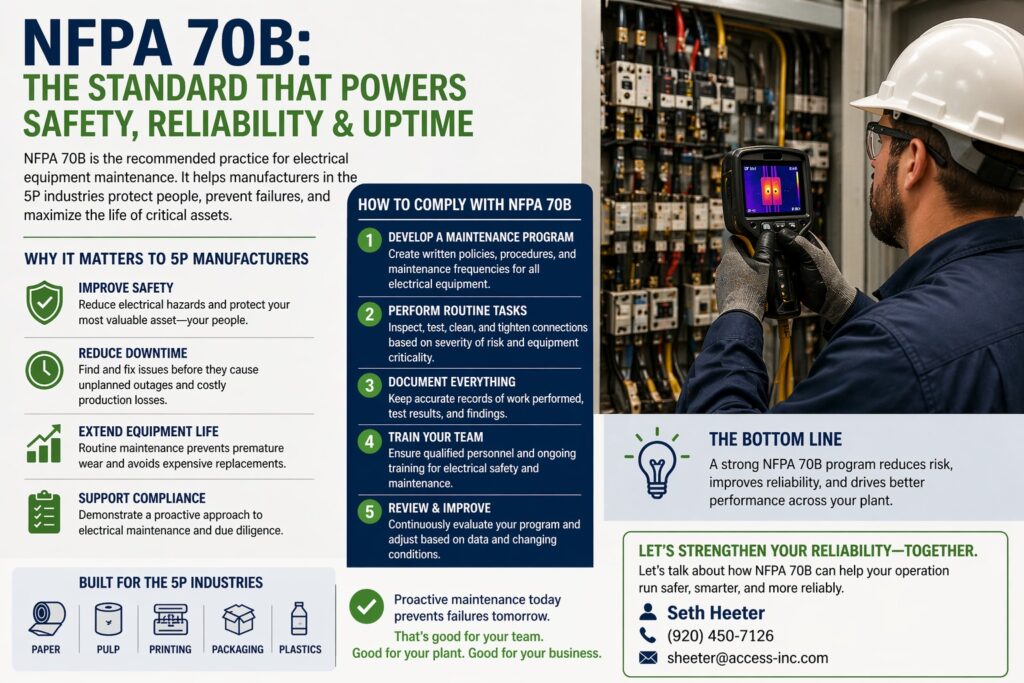
The National Fire Protection Association’s NFPA 70B has long been a trusted guide for electrical equipment maintenance, but the 2023 edition transformed it from a recommended practice into a mandatory standard. This change, effective January 16, 2023, means that facility owners and managers now have a formal obligation to develop and follow an Electrical Maintenance Program (EMP) for their power distribution systems. In industries such as print, pulp, paper, packaging and plastics, collectively known in Wisconsin as the 5P industries, these changes are particularly significant. These sectors employ roughly 150,000 people in Wisconsin alone and depend heavily on reliable electrical systems to keep operations running.
For the general managers who oversee production lines and budgets, NFPA 70B compliance isn’t simply a checkbox; it’s a pathway to lower risk, reduced downtime and longer equipment life. This article explains what the new standard requires, why it matters to 5P businesses, and how to build a compliance strategy.
Why NFPA 70B Matters for the 5P Industries
Electrical distribution and power-transfer systems are among the leading causes of industrial fires. Unmaintained or poorly maintained equipment is a key contributor to failures, fires and unplanned outages. NFPA 70B aims to break this cycle by mandating proactive maintenance and documentation to improve safety and reliability. The standard also feeds into the “cycle of safety,” complementing the National Electrical Code (NEC) and NFPA 70E (electrical safety in the workplace). Following NFPA 70B helps organizations meet Occupational Safety and Health Administration (OSHA) expectations for electrical safety.
For 5P businesses, compliance offers tangible benefits:
- Reduced downtime and waste: Condition-based maintenance catches problems before they cause shutdowns. Thermal imaging and other predictive tests uncover loose connections, overloaded circuits or failing components.
- Enhanced safety: By addressing the condition of maintenance, NFPA 70B reduces the likelihood of arc-flash incidents, shocks or fires. Worker safety becomes part of the maintenance plan rather than an afterthought.
- Lower operational costs: Preventive maintenance extends equipment life and reduces expensive emergency repairs. Regular breaker maintenance (cleaning contacts, testing trip units and lubricating moving parts) prevents nuisance trips and catastrophic failures.
- Regulatory and insurance compliance: Insurers and regulators increasingly require adherence to recognized standards; noncompliance can lead to denied claims and legal penalties.
Key Requirements of NFPA 70B
The heart of NFPA 70B is the Electrical Maintenance Program (EMP). Chapter 4 of the standard makes it clear that the equipment owner must implement and document an EMP. The EMP must include nine key elements to ensure accountability and continuous improvement:
- Electrical safety program: A documented safety program that addresses the condition of maintenance and complements the NFPA 70E electrical safety work program.
- Personnel responsibilities: Identification of qualified personnel responsible for each element of the maintenance program.
- Survey and analysis: A thorough survey of electrical equipment and systems to determine maintenance requirements and priorities.
- Maintenance procedures: Developed and documented maintenance procedures for all equipment within the program’s scope.
- Inspections, servicing and tests: A plan that defines inspection methods, servicing routines and suitable tests.
- Documentation and records: Policies for maintaining maintenance, equipment and personnel records. Section 8.6.2 of the standard specifies that test records must identify the tester, equipment, environmental conditions, date, type of test and pass/fail criteria.
- Corrective measures: Processes to prescribe, implement and document corrective actions based on collected data.
- Design for maintainability: Procedures to incorporate maintainability into new installations and retrofits.
- Program review and revision: A process for periodic review and revision of the EMP to incorporate failures and findings. The program must be audited at least every five years.
In addition to these core elements, some compliance guides also note that an EMP should also identify personnel responsibilities, plan inspections and define documentation and record retention policies.
Condition-Based Maintenance and Equipment Assessments
The 2023 NFPA 70B introduced Equipment Condition Assessments (ECAs) to determine maintenance intervals. Maintenance scopes and intervals are now based on three factors: physical condition, criticality, and operating environment, where the worst-rated factor sets the frequency. Unserviceable or nonconforming equipment requires immediate action, and a decal system must be applied after servicing to show the equipment’s maintenance condition.
Equipment is categorized into three condition levels:
- Condition 1: Like-new equipment with no unresolved maintenance issues. It requires routine inspections at least annually.
- Condition 2: Minor deviations from optimal performance; previous maintenance revealed issues or predictive monitoring suggests increased maintenance frequency.
- Condition 3: Significant deviation or missed maintenance cycles, unresolved notifications or urgent issues from predictive techniques. NFPA 70B mandates infrared inspection at least every six months for Condition 3 assets, while all assets must be inspected at least annually.
By basing maintenance intervals on actual equipment condition and criticality, NFPA 70B ensures that resources are focused where they are most needed and that equipment with higher risk receives more frequent attention.
Thermal Imaging and Testing
Infrared (IR) thermography is highlighted as one of the most effective tools for early detection of electrical problems. NFPA 70B’s Section 7.4 requires that temperature differences (ΔT) be measured and documented when inspecting electrical components. IR scans detect abnormal heat signatures, such as loose connections or overloaded circuits, and help identify hidden issues before they lead to failures. For equipment in Condition 3, thermography inspections are required at least every six months, and at least once a year for other equipment. Thermal imaging equipment should support multiple spot meters, isotherms and proper documentation.
Besides thermography, NFPA 70B prescribes a variety of fundamental tests, including online and offline tests, enhanced diagnostic tests and system studies. Chapter 8 categorizes tests into four types (online standard, online enhanced, offline standard, offline enhanced) to provide appropriate diagnostics depending on the equipment’s state. Periodic maintenance procedures such as visual inspection, cleaning, lubrication, mechanical servicing and electrical tests are required across equipment categories. Circuit breakers, for instance, must be cleaned, contacts inspected for wear or corrosion, trip units tested and moving parts lubricated. Other predictive techniques like vibration analysis, insulation resistance testing and partial discharge analysis can further enhance reliability.
Implementation Steps for Compliance
An effective compliance strategy involves more than just buying thermal cameras. The following steps, drawn from multiple sources, provide a roadmap:
- Assign an EMP coordinator: NFPA 70B requires that one individual be designated to oversee the program’s implementation and operation. This person should receive comprehensive training and participate in annual audits.
- Inventory and assess equipment: Conduct a thorough assessment of electrical infrastructure to determine the condition and criticality of each asset. Update single-line diagrams and system studies (short-circuit, coordination and incident energy analyses) if they are more than five years old.
- Develop procedures and schedules: Create detailed maintenance procedures for each equipment type, including inspection frequencies, test methods and pass/fail criteria. When manufacturer guidelines are unavailable, follow the intervals specified in NFPA 70B’s Table 9.2.2.
- Conduct routine inspections and tests: Perform thermography inspections, breaker testing, insulation resistance tests and other diagnostics according to the equipment’s condition category.
- Document everything: Maintain records of tests, results, corrective actions, personnel qualifications and equipment conditions. Documentation supports audits and informs future maintenance decisions.
- Integrate with safety programs: Coordinate the EMP with NFPA 70E’s electrical safety work practices to ensure that maintenance activities align with safe work procedures.
- Design for maintainability: When upgrading or installing equipment, consider designs that allow safe and efficient access for maintenance.
- Review and improve: Perform program reviews at least every five years and revise procedures based on failures, findings and new technologies.
Consequences of Noncompliance
Noncompliance with NFPA 70B isn’t simply a matter of receiving a citation. Failing to maintain electrical equipment can lead to missed inspections, deferred repairs and accelerated equipment deterioration. The most severe consequences are injuries and fatalities caused by arc flashes, electrical shocks or fires. From a business perspective, noncompliance increases liability risks, may result in denied insurance claims and higher premiums and can trigger fines or operational restrictions during regulatory audits. In contrast, organizations that maintain a strong EMP enjoy smoother audits and a competitive edge when bidding for contracts.
Looking Ahead: The 2026 Edition
NFPA 70B continues to evolve. The 2026 edition introduces new requirements, including continuous thermal monitoring using 24/7 sensors, enhanced transfer switch maintenance protocols, cybersecurity for operational technology and structured maintenance intervals based on the Potential Failure–Functional Failure (P–F) curve. Repair timelines have also been formalized, requiring prompt action on identified defects. Staying abreast of these updates will ensure that your maintenance program remains compliant and effective.
Conclusion and Call to Action
NFPA 70B’s transition to a mandatory standard underscores a broader shift toward proactive maintenance and safety. For the 5P industries, where continuous production and high energy demands make unplanned outages costly, adopting NFPA 70B can improve reliability, protect employees and reduce total cost of ownership. By implementing a structured EMP, conducting condition-based maintenance and documenting every step, businesses position themselves for safer operations and regulatory confidence.
Are you ready to take the next step toward compliance?
As a general manager or operations leader, you don’t have to navigate NFPA 70B alone. Access is here to help your organization interpret the standard, develop a customized maintenance program and coordinate services such as infrared scanning, breaker testing and documentation. To learn more or to schedule a consultation, please reach out at:
- Seth (GBIG)
- Phone: (920) 450-7126
- Email: sheeter@access-inc.com
By investing in a thorough maintenance program today, you can protect your people, your equipment and your bottom line tomorrow.