
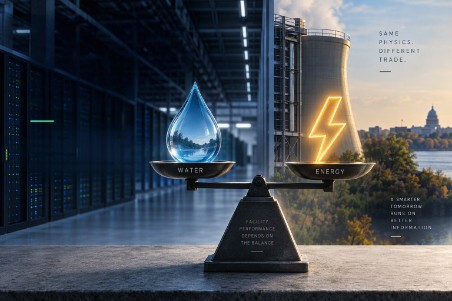
A mandate to eliminate cooling water sounds like a single decision. At the room and hall scale most of us actually operate, it's a water-versus-energy trade you have to size on purpose, not by accident.
It usually arrives as a directive from somewhere above the facilities team: get our cooling water use to zero. The intent is good. The framing hides the engineering. There is no method that makes cooling water disappear; there are methods that move the cost from the water bill to the energy bill, and the right choice depends on your climate, your density, and how you plan to run.
This is a facility-scale problem, not a hyperscale one. The building we are describing is a data hall, an enterprise data center, a set of MDF and IDF rooms, or a close-coupled cooling layout feeding a handful of higher-density racks. The physics is the same as the big campuses. The knobs you get to turn are different, and the decision lands on a smaller team with less room to eat a mistake.
Why the trade exists at all
Cooling rejects heat. Every method spends something to do it, and the cheap input for one is the expensive input for another.
An evaporative system (cooling tower, or an evaporative assist on a chiller) sheds heat by evaporating water. It is efficient on energy, which is exactly why it became the default for heat-dense rooms. It is also consumptive: it loses water continuously to evaporation, to drift (the fine mist carried off the tower), and to blowdown (the water bled off to keep dissolved solids from concentrating). Those three losses are the "where did the water go" answer, and they run whenever the system runs.
A closed-loop chiller or a dry cooler takes the other side of the trade. The working fluid stays in a sealed loop, heat is rejected to the air through a coil, and on-site water use drops toward zero apart from minor makeup. What you spend instead is electricity. Rejecting the same heat load without the help of evaporation takes more compressor and fan energy, and that shows up directly in your PUE. "Zero water" is real, but it is not free; you bought it with power.
Adiabatic and hybrid coolers sit between the two, spraying water only during the hottest hours to boost a dry cooler's capacity. They are a genuine middle path, but they are a spectrum, not an escape from the trade. The more hours you let them spray, the closer their water behavior moves back toward an evaporative tower's.
Wisconsin's climate changes the math, but doesn't remove it
Here is where a cold-climate facility has a real advantage. For a large share of the year, deep winter and the shoulder seasons, outside air is cold enough that a dry cooler or air-side economization can carry much of the load with little or no compressor work. That narrows the energy penalty of going water-light, sometimes dramatically.
It narrows it; it does not erase it. Peak summer is still peak summer, and a sustained high-density training or compute run generates heat around the clock regardless of the season. Size your system only for the easy months and you will find the gap on the worst week of the year. The honest design accounts for the summer envelope and the ASHRAE thermal limits your equipment has to stay inside, then decides how much water-free operation it is willing to pay for at the peak.
Liquid cooling doesn't settle the water question
Rack densities are climbing fast enough that air alone runs out of room. As a rough field marker, air cooling gets impractical somewhere above roughly 20 to 30 kW per rack, and next-generation AI hardware is pushing toward 100 kW per rack, which forces direct-to-chip or immersion liquid cooling. If you are planning dense racks, liquid is coming whether or not you were thinking about water.
It is worth being precise about what liquid cooling changes. It changes how heat is captured off the chips. It does not, by itself, change how that heat leaves the building. If the loop that pulls heat off the processors ultimately dumps it into an evaporative tower, you are still consuming water at the rejection stage. Direct-to-chip is a density and efficiency decision first. Whether it also reduces water depends entirely on what you attached to the other end of the loop.
You can't manage a trade you don't measure
The most common failure we see is not choosing the wrong method. It is not knowing which method's costs you are actually paying. Facilities frequently can't produce their cooling energy or their water split on request, because nothing downstream of the main meter is sub-metered. When the numbers aren't visible, the trade gets made by default and discovered later on a utility bill.
Two metrics make it visible. PUE tells you how much total energy you spend for every unit that reaches the IT load, so it captures the power penalty of going water-light. WUE tells you how much water you consume per unit of IT energy, so it captures the water side. Track both and the trade stops being abstract; you can see exactly what you bought. This is where ACSI monitoring earns its place: continuous sub-metering and trend data on the cooling system so the split you designed for is the split you can prove you're getting, season over season.
Engage before the topology is locked
The reason to have this conversation early is simple economics. Before the cooling topology is set, water-versus-energy is a design choice: you can model your climate hours, your density curve, and your summer peak, and pick the point on the trade that fits. After the topology is poured and piped, the same decision becomes a retrofit: new equipment, new penetrations, downtime, and a much bigger number.
That early-engagement window is where an engineering partner does the most good. Bringing Access in before building planning starts, rather than after the walls are up, is consistently where the cost comes out of a project. We would rather help you size the trade on paper than help you unwind it in the field.
The takeaway isn't that closed-loop is good or evaporative is bad. Each buys you something and charges you for it. The mistake is treating "zero water" as a free win instead of the water-for-energy trade it actually is, and locking it in before anyone has measured what it costs.
So the question for your next build or refresh is straightforward: do you know which side of the water-energy trade your cooling design is on right now, and can you prove it with a meter?
If you're weighing a cooling topology for a data hall, MDF/IDF build, or a density upgrade, Access can model the water-versus-energy trade before it's locked in, and ACSI can keep it measured once you're running. A short early conversation is usually the cheapest part of the whole project