
Wisconsin sits beside a fifth of the world's surface fresh water, but that abundance says almost nothing about what a single facility can permit, draw, or afford to consume. At enterprise scale, cooling architecture is what sets your exposure.
Most water conversations about data-scale infrastructure start at the wrong end. They start with the region: the Great Lakes hold roughly 21% of the world's surface fresh water, so surely water is not the constraint. For the owner of an enterprise data center, an MDF/IDF build, or a high-density computer room, that framing is close to useless. You do not draw from the Great Lakes. You draw from a municipal connection or a local supply, under a permit envelope and a water bill that answer to your site, not to the region. And the single biggest factor in how much water that site needs is a decision you make early: the cooling architecture. By the time the design is locked, your water exposure is largely locked with it.
Abundance is regional; your draw is local
Availability at a specific site is a function of what the local supply and the permitting process allow, and of how much water your systems consume rather than return. Two facilities a few miles apart can face very different answers depending on the capacity of the system they connect to. Regional abundance does not change that. What you can influence, heavily, is how much water your facility asks for in the first place. That is an engineering decision, and it is cheapest to shape before the mechanical design is finalized.
Cooling architecture sets your water exposure
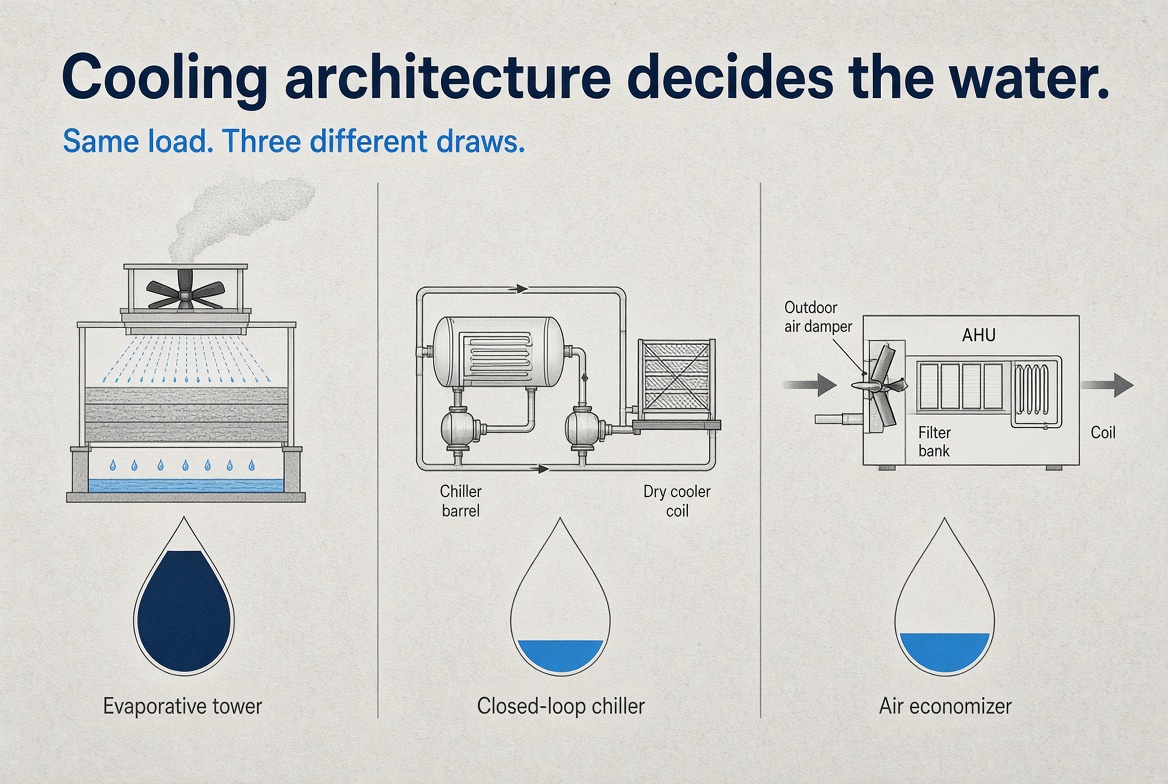
Three broad approaches dominate at the scale Access serves, and they sit at very different points on the water-versus-power trade.
Evaporative cooling (cooling towers and evaporative-assisted systems) is efficient on energy. It achieves that efficiency by evaporating water, and it loses volume continuously through three paths: evaporation, drift (fine droplets carried off in the airstream), and blowdown (water bled off to keep dissolved solids from concentrating). A large share of what an evaporative system draws never returns to the watershed. If your priority is energy efficiency and your local water supply is ample and cheap, evaporative cooling can make sense. But it is the highest-water-exposure option, and it ties your operation to a continuous water draw.
Closed-loop chiller systems sit at the other end. They recirculate refrigerant or fluid and consume almost no water beyond minor makeup. The trade is electricity: a closed-loop system generally spends more energy to reject the same heat. This is the water-for-power exchange in its clearest form. If your site is water-constrained or you want to minimize permitting and consumptive-use exposure, closed-loop shifts the burden onto the electrical side, which then has to be planned for.
Air-side economization uses outside air to cool directly when conditions allow, and Wisconsin's climate is a genuine asset here. For a meaningful portion of the year, especially winter and shoulder seasons, outside-air or dry-cooler operation can carry much of the load with little or no water and modest energy penalty. Peak summer and sustained high-density workloads may still require mechanical cooling, but a design that leans on economization where the climate permits reduces both water and energy over the year.
Two numbers make the trade legible
If you want a single lens on the water side, water-use effectiveness (WUE), liters of water per kilowatt-hour of IT load, makes the exposure comparable across designs, the way PUE does for energy. An evaporative-heavy design and a closed-loop design can deliver the same computing at very different WUE and PUE, and the right answer depends on your site: local water cost and availability, electricity cost, permitting headroom, and the climate you can lean on. There is no universal best; there is a best for your parcel. ASHRAE's thermal guidelines matter here too, because a wider allowable temperature and humidity envelope lets a facility run more hours on economization and less on water- or energy-intensive mechanical cooling. Designing to the widest envelope the equipment safely tolerates is one of the cleanest ways to reduce both water and power exposure at once.
Density is pushing the decision
The reason this matters more now than it did five years ago is rack density. Traditional air cooling starts to lose the fight somewhere around 20 to 30 kW per rack. Above that range, moving enough air becomes impractical, and liquid cooling (rear-door heat exchangers, in-row and close-coupled units, and direct-to-chip loops) enters the picture. As AI-oriented workloads push density higher, more enterprise rooms are crossing into that territory.
There is a common misconception worth flagging: liquid cooling does not automatically reduce water use. Direct-to-chip and immersion move heat away from the silicon far more effectively than air, but that heat still has to be rejected somewhere. If the final heat rejection runs through an evaporative tower, the water draw comes right back. Liquid cooling changes where and how heat moves inside the building; it does not, by itself, decide your water exposure. The heat-rejection choice does.
Measure what you actually use
You cannot manage exposure you cannot see, and water is frequently the least-instrumented utility in a facility. Sub-metering cooling water and correlating it with thermal load and IT load turns water from an annual line item into an operational metric: one you can trend, benchmark against water-use effectiveness, and act on. This is where ACSI comes in: ACSI sub-meters and monitors water and thermal performance on live systems, so consumption is measured against real load rather than estimated from nameplate assumptions. Monitoring also surfaces the drift in performance (scaling in a tower, a failing economizer damper, a chiller working harder than it should) that quietly raises both water and energy over time.
Design the exposure down, early
The through-line is simple. Regional abundance is not the same as what your site can permit or afford to consume, and the gap between the two is largely an engineering outcome. The cooling architecture you choose, how you reject heat, how much you lean on Wisconsin's climate, and how well you measure the result together determine how dependent your operation is on a constrained local water source.
Those choices are far cheaper to shape before the design is set than to retrofit afterward. Access works with owners early on cooling strategy (matching the architecture to the site's real water and power picture rather than to a regional assumption), and ACSI keeps the systems measured and maintained once they are running. If you are planning a build or a density upgrade and want the water and power trade-offs mapped before the design locks, that is the conversation to have first.
Takeaway: Abundance is a regional headline; your water exposure is a design decision made building by building. The question worth asking before the mechanical design is finalized: how much of your operation's resilience are you willing to tie to a water source you do not control?