
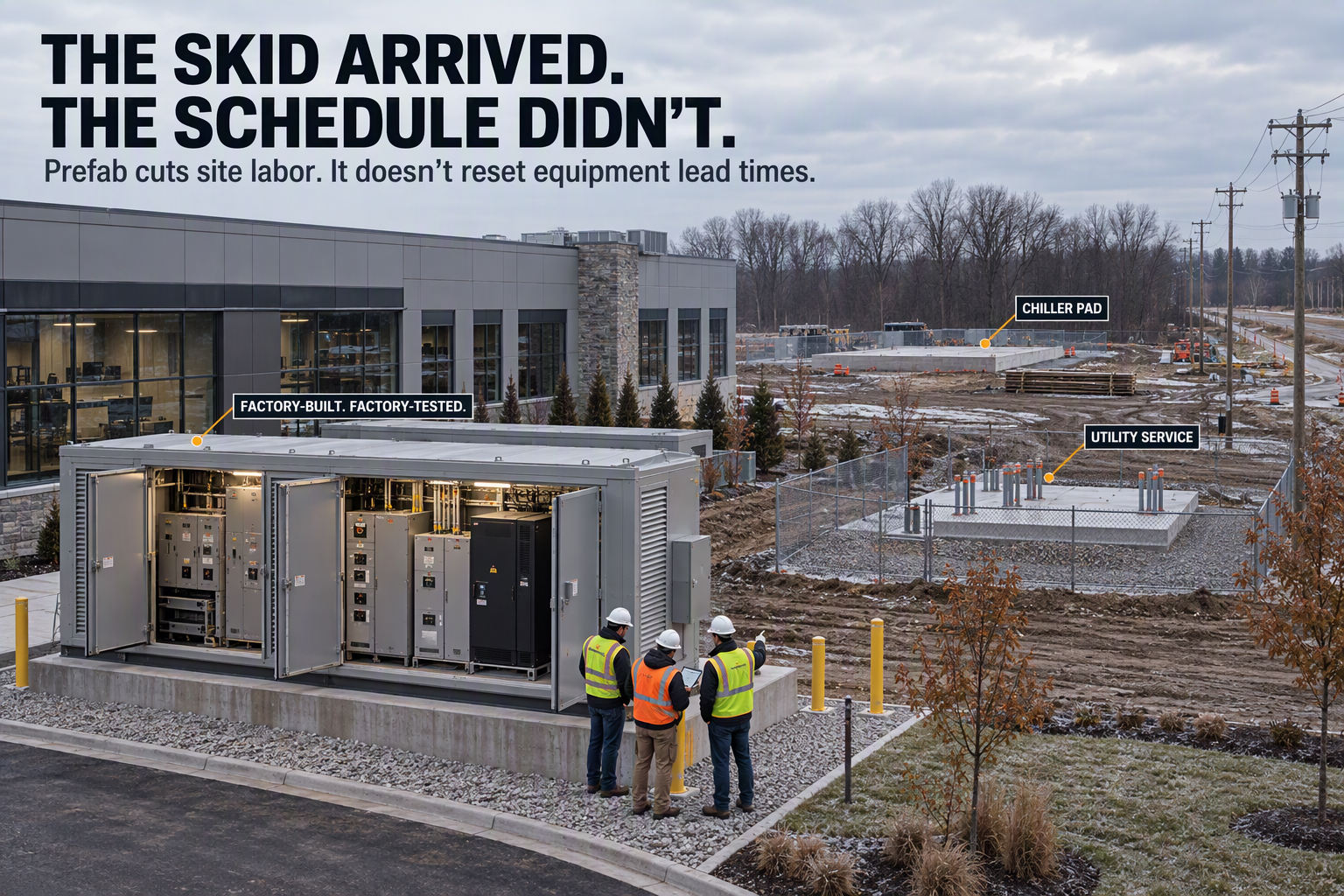
A prefabricated power block can take weeks of field work out of an enterprise build. It cannot take months out of the switchgear, the UPS, or the utility service that goes inside and behind it. Knowing which is which is how a schedule holds.
We get the same call more often than you would expect. A team has chosen a prefabricated, factory-integrated power block for a new enterprise data center or a build-out at the MDF, the vendor timeline looks short, and the assumption forms that the electrical scope is now fast. Then the project reaches the point where power has to actually be there, and the date slips, not because the modular approach failed, but because the parts of the schedule that modular never controlled were left unmanaged. This is worth walking through carefully, because prefabrication is a genuinely good tool when its limits are understood, and a source of false confidence when they are not.
What a prefabricated power block actually does for you
Start with what is real, because it is significant. When a power block is assembled and tested in a controlled shop rather than in your electrical room, several things improve at once. The terminations, bus connections, and internal wiring are done under factory conditions by a consistent crew, which reduces defects. The unit arrives with factory acceptance testing already performed, so a class of problems is caught before the block ever reaches your site. And the on-site work collapses from a lengthy field-assembly effort into a set, connect, and commission sequence.
At enterprise and MDF/IDF scale, that last point matters more than it first appears. The electrical room is usually where trades stack up and get in each other's way late in a project. Pulling most of that work out of the field removes a common source of schedule variability and a common source of rework. For a build exposed to a northern construction season, it also shrinks the portion of the job that is hostage to weather. None of this is marketing. It is a real reduction in execution risk, and it is the right reason to choose a modular approach.
Where the schedule actually lives
Here is the part that gets missed. A prefabricated power block is an enclosure and an integration method. It is not a way to manufacture the components inside it any faster. The switchgear, the UPS, the distribution gear, and the transformer feeding the room are ordered from the same supply chain on the same lead times whether they end up in a factory-built skid or a stick-built room.
Those lead times are the real schedule. In current conditions we routinely see switchgear running a year or more. UPS and power-distribution equipment that historically arrived in three to six months now stretches toward nine to twelve when backlogs are deep. Chillers and cooling equipment sit around six to nine months. Large standby gensets can run six to twelve months and longer when the order book is full. A factory-integrated block does not shorten any of these; it simply houses them. If the switchgear is fourteen months out, the block cannot be completed and shipped until that switchgear exists, and the "fast" modular timeline quietly inherits the slowest component inside it.
Then there is the utility service, which sits entirely outside the block and is frequently the true gate. A new or upgraded service, the utility-side transformer, and the interconnection work behind it operate on the utility's calendar, not the vendor's. We have watched more than one build finish its interior, set its power block, and then wait on the service that energizes it. Prefabrication does nothing for that path.
Planning so the modular schedule is real
The good news is that all of this is manageable, and the discipline is the same discipline that makes any critical-power build predictable. It starts earlier than most people expect.
Engage before the building layout is locked. The most expensive lead-time problems are the ones discovered after the design is frozen, when the only options left are to wait or to redesign. When we are brought in early, we can identify the long-lead items on day one and get them on order while the rest of the design proceeds in parallel.
Pre-order the long-lead components ahead of the enclosure. The switchgear and UPS do not care that the skid has not been designed yet; they need to be in the queue. Ordering critical gear up front, and dual-sourcing where a single supplier is a risk, is often the single biggest lever on the delivered date.
Phase the electrical to match how load actually shows up. Rather than sizing and buying everything for a distant full build, deploy standardized power increments as demand materializes, and bridge early phases with the capacity you can get firm sooner. This is where modular and phasing reinforce each other: a repeatable, standardized block is exactly what you want to deploy in increments, and phasing keeps you from waiting on the last, largest component before anything can run.
Treat the utility service as its own project with its own timeline, started as early as possible. And build float into the schedule deliberately, because a plan with no margin against a long-lead slip is a plan that will slip.
Where Access fits
This is the work we do. Access plans phased electrical build-outs at enterprise and MDF/IDF scale, identifies the long-lead items early, and gets critical gear on order before it becomes the constraint. We now also represent utility-scale transformers, which lets us shorten one of the longest clocks on the board and help power actually reach the site rather than stopping at the property line. Once a power block is energized, ACSI provides the commissioning, monitoring, and lifecycle maintenance that keeps it reliable in service.
Modular construction is a tool we use and recommend in the right application. What we do not do is let a short vendor timeline stand in for a real deployment schedule. The block can arrive in weeks. The gear inside it and the service behind it are measured in months, and those are the numbers that decide your date.
Takeaway: Choose modular for the field-risk and standardization benefits it genuinely delivers, then plan the long-lead procurement and utility service as if the modular timeline did not exist. On those items, it does not.
A question worth answering before you commit: on your next build, what is the lead time on the switchgear and the utility service? And is anyone managing those two clocks, or just the vendor's ship date?