
The grid is arguing about resource adequacy at regional scale. The same argument plays out inside every enterprise power room and network closet, just faster and quieter, and it usually goes unnoticed until the day there's no room left to add a circuit.
A facilities manager calls because a new set of cabinets won't energize cleanly. The gear is on site, the racks are bolted down, and the project has a date. Then the electrician opens the panel and finds it: no open poles at the right rating, feeders already carrying more than the drawings assumed, and a UPS that was specified for comfortable redundancy now running much closer to its limit than anyone realized. Nothing failed. The room simply ran out of margin while everyone was watching the workload instead of the power path.
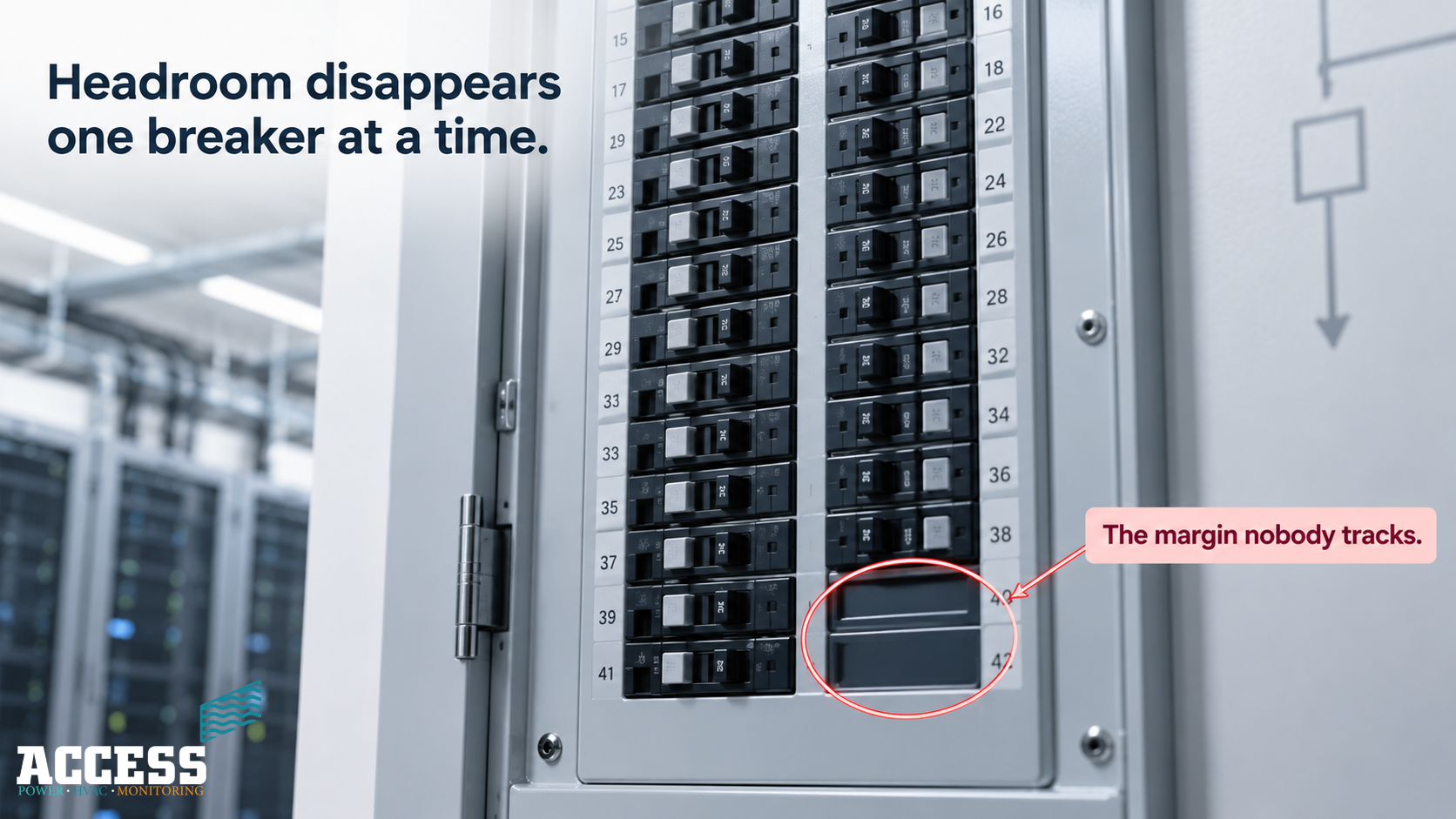
We see this pattern often enough that it's worth naming plainly. Every critical facility is commissioned with a reserve margin, and almost nobody tracks it after day one.
The reserve margin nobody tracks
When a power room is designed, it carries headroom on purpose. Spare capacity in the panelboards. Feeders sized above the initial load. Redundancy on the UPS and, often, on the distribution path. That headroom is the facility-level version of what a grid planner calls a reserve margin: the buffer between what the system can deliver and what it's currently being asked to deliver.
The difference is that a utility reserve margin is forecast, reported, and argued over in planning dockets. A building's reserve margin is invisible after commissioning. It lives on a single-line drawing in a folder, and it gets spent one small decision at a time: a couple more cabinets here, a denser configuration there, a circuit backfilled into the last spare breaker because it was the quickest way to hit a deadline. Each decision is reasonable on its own. Together, over a few years, they quietly consume the margin the original design paid for.
Where the headroom actually goes
The erosion has a few predictable sources, and most of them are easy to check.
The 80% rule. Under the NEC, a branch circuit or feeder serving a continuous load, one expected to run at its maximum for three hours or more, may be loaded to no more than 80% of the overcurrent device's rating. Steady IT load is the textbook continuous load. That means a 100-amp feeder gives you 80 usable amps for the gear it serves, not 100. When people estimate remaining headroom off the breaker nameplate, they consistently overestimate what's actually available.
Rising density. A power room designed a few years ago was likely planned around cabinets in the 3-to-5 kW range. Current and near-future gear routinely lands at 15-to-20 kW per rack and higher. Even if the rack count never changes, the load behind each rack can quietly multiply, and the feeders and UPS that looked generous against the old assumption look tight against the new one.
Backfilled redundancy. The most expensive kind of erosion is the kind that eats your N+1. A UPS specified so that a spare module covers a failure only holds that promise while real load stays below the design point. Push actual load up toward capacity and the redundancy is still drawn on the single-line, but in practice, a failure now sheds load instead of riding through. The drawing says N+1; the room behaves like N.
Redundancy on the drawing versus redundancy in reality
This gap between the documented design and the as-operated reality is the heart of the problem. Almost every uncomfortable capacity conversation we walk into starts the same way: the paperwork describes a resilient system, and the meter readings describe a full one.
It's worth checking three things directly rather than trusting the record. What is each critical feeder actually pulling under normal operation, against its 80% continuous ceiling? How much real load is on each UPS relative to the point where its redundancy still holds? And how many genuinely usable spare positions remain in the panels at the ratings you'd actually need? None of that requires a forklift. It requires someone to read the current state of the power path instead of the drawing of it.
The same problem, one scale up
There's a reason this rhymes with the news. Across the Midwest, regional planners are watching load climb into a thinning reserve margin faster than firm capacity is being added, because new generation and the transmission to deliver it take years to bring online. The grid can't simply conjure headroom on the day it's needed; the lead times don't allow it.
A building is the same physics on a shorter clock. You can add capacity faster than a utility can — but only if you see the pinch coming while there's still slack in the schedule and the budget. The facilities that get squeezed are the ones that discover the margin is gone at the same moment they need it, which is exactly when adding it is most disruptive and most expensive.
Catching it early is cheaper than catching it full
The pattern we'd rather help customers avoid is the deadline-day discovery. Getting involved before a room is full, ideally before the next expansion is even scoped, changes the options from emergency to engineering. There's room to rebalance circuits, to plan an upgrade on a normal timeline, to right-size the next UPS against real density instead of a stale assumption, and to sequence work around operations instead of against them.
That's the thinking behind a capacity-and-redundancy review of an existing critical power path: measure what the system is truly carrying, compare it against the ceilings that actually govern it, and surface the pinch points while there's still margin to design around. Where it makes sense, ACSI can carry that forward as continuous monitoring and a maintenance cadence, so the reserve margin is tracked as it changes rather than rediscovered when it's gone. Engaging early is consistently less expensive than being brought in once the closet is out of room.
The oldest, most reliable habit in critical power is to know your headroom before you need it. So it's worth asking about your own facility: when did anyone last measure what reserve is actually left on the power path, not on the drawing, but on the meter?