
Most unplanned outages in enterprise facilities don't start as failures. They start as drift: a slow move away from normal that nobody was watching. Continuous monitoring is what turns that hidden climb into a routine work order instead of an after-hours emergency.
The problem usually starts quietly
Walk into most network closets, MDF and IDF rooms, or enterprise data halls and you won't find equipment that is obviously failing. You'll find equipment that is running slightly differently than it was a few months ago. A room that sits a couple of degrees warmer. A UPS whose batteries are a little further into their life than the maintenance sticker suggests. A connection that reads warm under load but hasn't given anyone a reason to look at it.
None of that trips an alarm, because nothing has failed. That is exactly why it's dangerous. The condition that eventually takes a facility down is rarely a sudden event. It's a trend that was allowed to run because no one had visibility into the direction things were moving between service visits.
In our experience, the facilities that get surprised aren't the ones with bad equipment. They're the ones that only see their equipment on the day a technician happens to be standing in front of it.
Three kinds of drift worth watching
Most of the developing problems we see fall into a few recognizable patterns. None of them are exotic. All of them are catchable if someone is looking.
Thermal drift. Cooling problems almost always announce themselves as a temperature trend before they announce themselves as an outage. A supply-air setpoint that creeps up, a return-air sensor climbing week over week, or a hot aisle that no longer matches its neighbors are all early signals. ASHRAE's thermal guidelines for data processing environments exist precisely because sustained operation outside the recommended envelope shortens equipment life and raises failure risk. A single spot reading during a quarterly visit tells you where you are that day. It doesn't tell you which direction you've been heading.
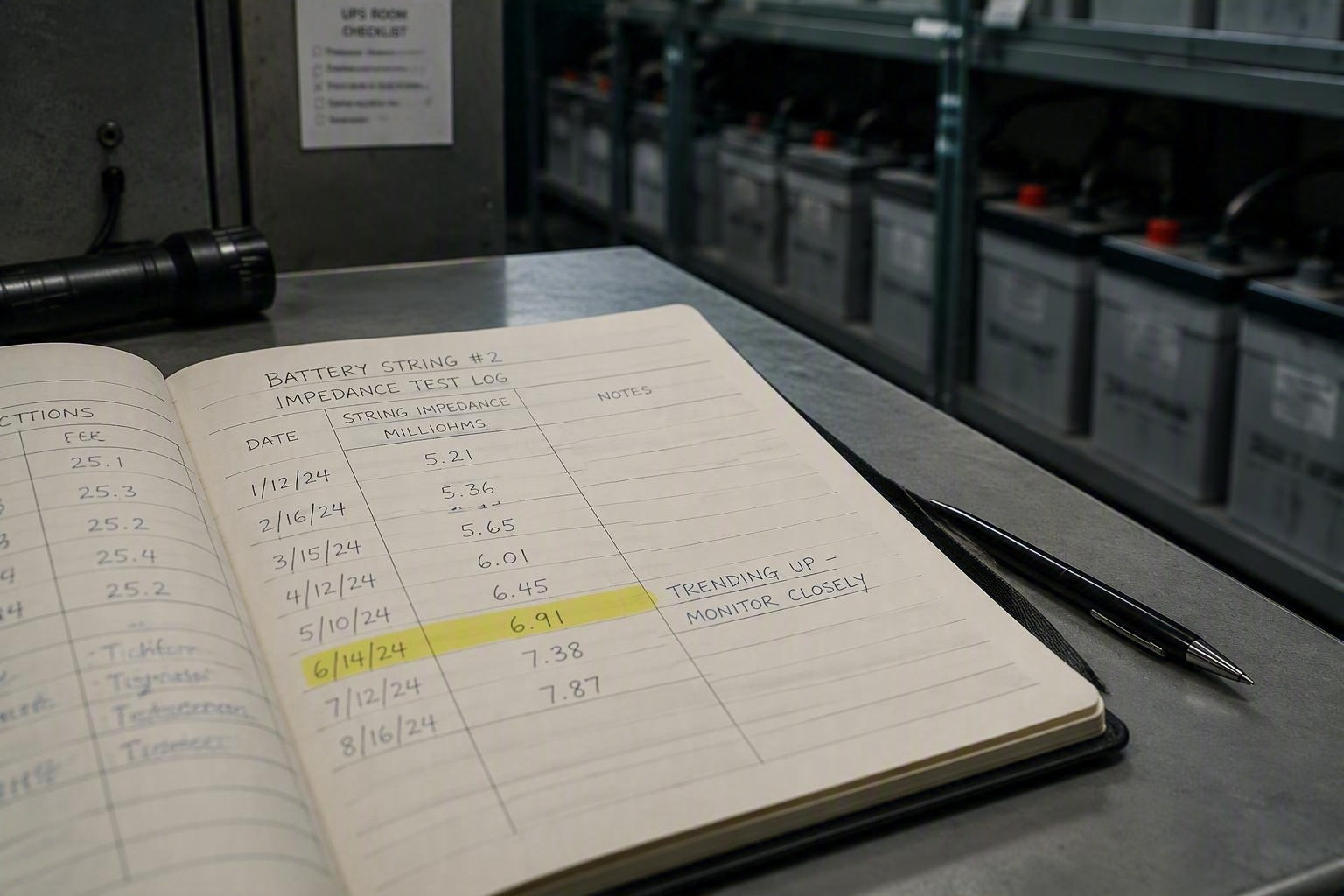
Battery degradation. The valve-regulated lead-acid (VRLA) batteries in most UPS systems carry a rated service life on the order of three to five years, but rated life and actual life are not the same thing. Internal impedance rises as a cell degrades, and impedance testing can flag a weakening string long before a discharge event would expose it. The failure mode people fear, the UPS that can't hold the load when it's finally needed, is usually the end of a slow decline that was measurable months earlier.
Connection heat. Loose or corroded electrical connections heat up under load, and that heat is one of the most reliable early indicators of a developing electrical fault. Infrared thermography is the standard tool for finding these before they arc or fail. NFPA 70B, now positioned as a maintenance standard rather than a recommendation, pushes facilities toward exactly this kind of documented, condition-based electrical maintenance, finding the warm connection while it's still a torque check, not a burned bus bar.
Why a quarterly visit isn't the same as visibility
Scheduled maintenance matters, and there's no substitute for a qualified technician physically inspecting critical equipment. But a periodic visit is a series of snapshots. Between those snapshots, a facility is effectively running blind, and drift doesn't wait for the calendar.
This is the gap that catches people. A room can pass a spring inspection and be well outside its thermal envelope by midsummer. A battery string can test acceptably in one quarter and cross into trouble before the next visit. The problem isn't the quality of the inspection. It's the interval between inspections, and the fact that a developing condition doesn't care when the next one is scheduled.
Continuous monitoring closes that gap. Instead of learning a room's condition four times a year, you see the trend continuously, which means you find out about a climb while it's still small and correctable rather than after it has already done damage.
The spaces most likely to go unwatched
At enterprise scale, monitoring attention tends to follow the equipment people consider important. The main data hall gets sensors, dashboards, and regular eyes. The smaller distribution spaces often don't.
That's a problem, because a network closet or a remote IDF is frequently the point where availability actually breaks. These rooms carry real load, sit in converted or shared spaces that were never purpose-built for heat rejection, and get visited far less often than the primary hall. A closet with a single wall-mount cooling unit and no independent environmental monitoring can drift well out of its envelope for weeks before anyone notices, usually when equipment starts throttling or dropping.
The pattern we see is consistent: the failure lands in the space that got the least visibility, not the one with the worst equipment. Extending continuous monitoring to the closets and distribution rooms (not just the flagship hall) is often the single highest-value change a facility can make, precisely because those are the spaces where drift currently runs unwatched.
What continuous monitoring changes
This is where ACSI monitoring fits. Rather than treating a facility as a set of quarterly snapshots, ACSI monitoring watches the direction critical spaces are moving (thermal trends, power and battery condition, and the environmental signals that precede most failures), so a developing problem surfaces as a maintenance ticket instead of an outage.
The practical difference is what a given event turns into. With visibility, a rising temperature trend becomes a filter change or an airflow adjustment. An impedance reading creeping upward becomes a planned battery replacement scheduled on your terms. A warm connection flagged on an infrared scan becomes a torque check on a work order. Without visibility, each of those same conditions eventually becomes an unplanned shutdown, on the equipment's schedule rather than yours, and almost always at a worse time and a higher cost.
That's the quiet value of monitoring. When it's working, the failures it prevents never happen, so they never make the report. The uneventful facility isn't the one where nothing goes wrong. It's the one where everything that starts to go wrong gets seen early enough to stay small.
Getting ahead of the drift
If you can't currently see how your critical spaces are trending between service visits, that's usually the first thing worth fixing, before any larger investment in redundancy or capacity, because you can't manage a risk you can't see. The right starting point is an honest look at what you're already monitoring, what you're assuming is fine because it hasn't alarmed, and where a developing condition could run unwatched today.
That's a conversation the ACSI team has regularly, and it's a good one to have before the next surprise rather than after it. If you'd like to understand where your facility currently has visibility and where it doesn't, [reach out to the ACSI monitoring and maintenance team]. We can walk the gaps with you.