
Enhance Data Center Cooling Efficiency in 4 Steps
Balancing cost savings with shrinking carbon footprints can be challenging, yet data centers offer a unique opportunity to achieve both. Let’s explore how you can enhance cooling efficiency while being environmentally conscious.
Data centers, as highlighted by the Uptime Institute, account for up to 35% of total energy consumption in non-manufacturing, information-focused enterprises. Despite their substantial energy demands, significant cost savings can be realized through strategic energy management.
As energy costs and the demand for data center cooling soar, adopting efficient cooling methods becomes essential. Implementing best practices not only optimizes your current operations but also prepares you for future challenges. Explore how you can boost your data center cooling performance today.
1. Optimize Your Data Center Sealing
Effective sealing of your data center is crucial as it forms the backbone of any cooling efficiency strategy. Poor sealing introduces humidity and cooling losses, hampering overall efficiency. To enhance sealing:
- Ensure all doors are closed consistently.
- Use a vapor seal with cost-effective materials like plastic film, vapor-retardant paint, vinyl wall coverings, and vinyl flooring to manage the data center climate.
- Address gaps around pipes and cables entering the data center through walls and raised floors.
- Conduct a data center assessment to fix any sealing inconsistencies.
2. Implement Hot-Aisle/Cold-Aisle Configurations
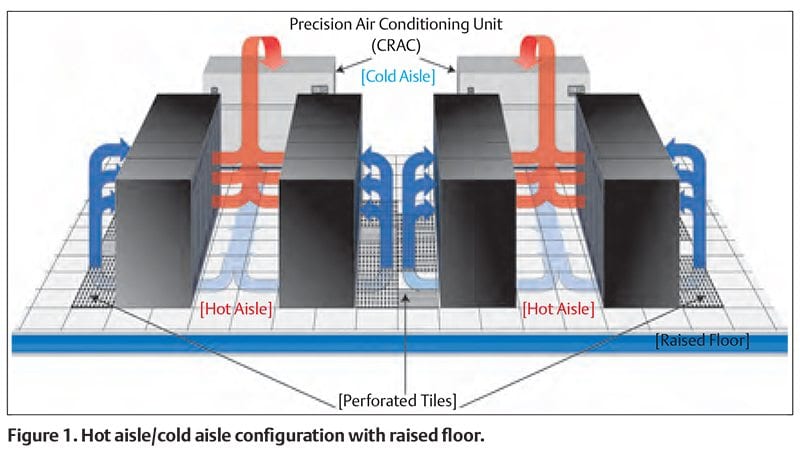 The essence of a hot-aisle/cold-aisle system is to optimize airflow, maximize the capacity of computer room precision air conditioners (CRAC), and minimize energy expenditure.
Racks are arranged to face one another, drawing cool air in, while hot air is expelled from the back, forming a hot aisle. CRAC units positioned perpendicularly to the hot aisles facilitate increased return air temperature and efficiency.
3. Utilize Aisle Containment Tactics
After establishing a hot-aisle/cold-aisle layout, the next step is to implement aisle containment techniques. By sealing aisles with panels and doors, you prevent the intermingling of hot and cold air. This low-cost strategy enhances the cooling capacity and energy efficiency, allowing for higher heat loads per rack. For detailed insights, refer to the white paper on “Focused Cooling Using Cold Aisle Containment.”
4. Adopt Intelligent Cooling Controls
Leverage advanced control systems like the Liebert DSE for high-efficiency cooling. This system optimizes component operations, reduces energy usage, and integrates diagnostics with data center management. It boasts up to 70% efficiency over comparable technologies by using dynamic fan control, compressor modulation, and precision sensors.
The Liebert iCOM enhances efficiency by separately controlling compressors and fans to align with IT loads and airflow needs, ensuring energy savings and preventing overcooling.
Seeking Assistance? We’re Here to Help
Facing growing demands, data center managers must prioritize energy consumption. By implementing the outlined practices, you can significantly curb cooling energy use. We’re committed to assisting you in crafting an energy-efficient plan tailored to your needs. Reach out to your local Liebert business partner to explore how we can help make your operations greener.
For more insights and updates on data center cooling innovations, sign up for Access’s newsletter today!
Data Center Cooling FAQ
- What is the significance of data center sealing? Proper sealing minimizes cooling losses and prevents humidity, forming the basis for effective cooling strategies.
- How does a hot-aisle/cold-aisle system benefit data center cooling? It optimizes airflow and enhances the efficiency of CRAC units by managing the flow of hot and cold air.
- What are the advantages of aisle containment? Aisle containment prevents air mixing, increases cooling capacity, and supports higher heat loads per rack.
- How do intelligent control systems enhance cooling efficiency? They optimize energy use by controlling components based on actual IT loads and airflow requirements, preventing unnecessary cooling.